The Evolution of Intelligence: From Biological to Lone Intelligence
P
Prof. RP Singh
July 13, 2026 · 3 min read
Image caption
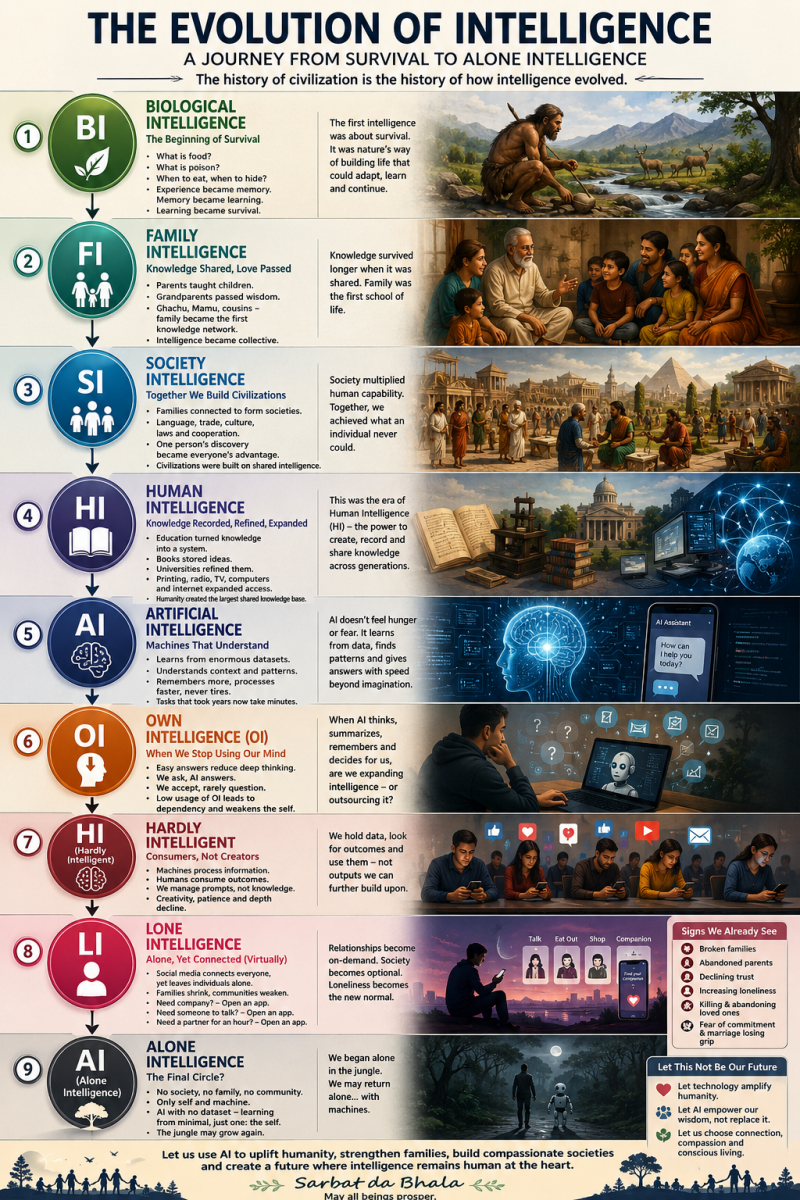
BI – Biological Intelligence
Life began with survival.
The first intelligence wasn't about mathematics, philosophy, or technology. It was about answering simple questions:
What is food?
What is poison?
When should I hunt?
When should I hide?
Experience became memory. Memory became learning. Learning became survival.
FI – Family Intelligence
Humans discovered that knowledge survives longer when it is shared.
Parents taught children. Grandparents passed wisdom. Uncles, aunts, cousins—family became the first distributed knowledge network.
Intelligence was no longer individual. It became collective.
SI – Society Intelligence
Families connected to form societies.
Language, trade, culture, laws, and cooperation multiplied human capability. One person's discovery became everyone's advantage.
Civilizations were built on shared intelligence.
HI – Human Intelligence
Education transformed knowledge into a system.
Books stored ideas. Universities refined them. Printing, radio, television, computers, and the internet expanded access.
Humanity created the largest shared knowledge base in history.
AI – Artificial Intelligence
Then came a different kind of intelligence.
AI doesn't experience hunger or fear. It learns from enormous datasets, understands context, remembers patterns, and processes information at incredible speed.
Tasks that once demanded years of study now take minutes.
The opportunity is extraordinary. The challenge is equally significant.
As AI grows stronger, our Own Intelligence (OI) risks becoming weaker if we stop thinking and only start asking.
When AI thinks, summarizes, remembers, and decides for us, are we expanding intelligence—or outsourcing it?
The Age of HI – Hardly Intelligent?
A provocative question:
If machines process information while humans merely consume outcomes, will we gradually lose the habit of deep thinking?
Instead of creating knowledge, we may become managers of prompts and consumers of conclusions.
LI – Lone Intelligence
The next stage may not be technological—it may be social.
Social media connects everyone yet often leaves individuals feeling alone.
Families are shrinking. Communities are weakening. Relationships are increasingly mediated by apps.
Need someone to talk to? Open an app.
Need company for dinner? Open an app.
Need emotional support? Open an app.
If every relationship becomes on-demand, society itself may become optional.
We already see signs of growing isolation, broken families, abandoned parents, declining trust, and increasing loneliness. These trends have many causes, and technology is only one of them, but they invite an important question:
Are we moving from Society Intelligence back to Lone Intelligence?
Perhaps the circle is closing.
We began alone in the jungle. We built families. We built societies. We built civilizations. We built machines.
Now, there is a possibility that machines become our primary companions while humans drift back toward isolation.
The final AI may not stand for Artificial Intelligence.
It may stand for Alone Intelligence.
I hope this future never fully arrives.
Technology should amplify humanity—not replace it.
No comments yet. Be the first!